在地球的另一邊觀看香港的繁華鬧市,都會人的感情掙扎和生存空間比真正踏足這片喧譁的土地來得更為真實。因為隔了6000多里的距離,我可以更客觀的去剖視我曾經接觸過的一切。地鐵列車,紅色小巴,街頭巷尾,唐樓門前的霓虹燈曾幾何時都那麼熟悉,但是我卻沒有深厚的體會。就像我在香港長大但一點不瞭解香港的歷史一樣。我不是唯一的一個。原因是在香港長大的孩子大部分沒有餘暇去顧及歷史,大家都為生活奔波勞命––所謂的“揾食"––然後拼命的去消費和吃喝玩樂。這就是香港人的生活態度,work hard, play hard, 沒有去想想這種 "work/hard" 模式是完全沒有任何意義,而且節奏也不是自己可以控制,最終得益的是大財團,大企業。香港的經濟發展倚賴香港人對這種“work/play" 不成文協議的同意和縱容。都說香港人工作壓力大,所以要放鬆,去旅行,浩浩蕩蕩地上飛機,離開香港人自豪的赤蠟角機場,下飛機,指手畫足評論人家的機場怎麼落後怎麼不如香港,到達酒店,吃飯,血拚,胡亂拍照,買一大堆手信,回港,派手信,上載那些沒有焦點的照片,繼續上班。又回到原來的工作週期。這是一般人的生活/旅遊循環。在2008年我感到厭倦了。
Thursday, June 10, 2010
Wednesday, May 26, 2010
Goodbye Lenin
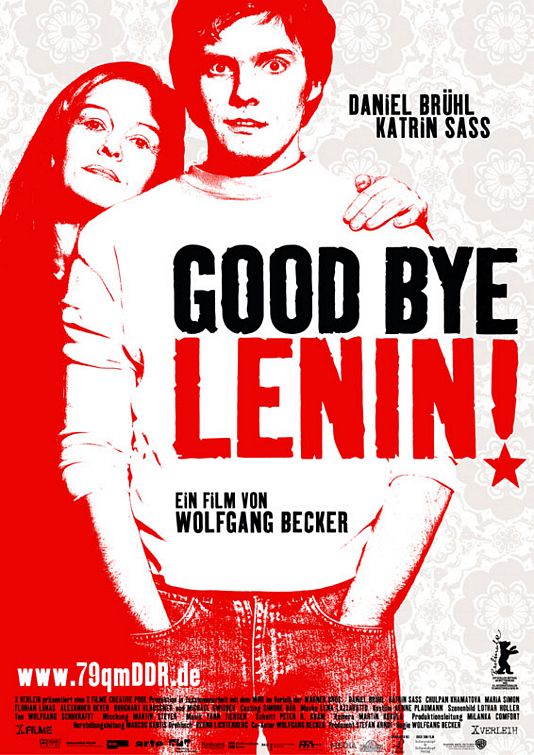
Goodbye Lenin: a masterpiece of a familial history against the backdrop of the collapse of the Berlin Wall in 1989. The core message, as I interpret it, is that each individual try their best to adapt to the colossal social change that results from the uneasy interaction of the discrepant political ideologies. Alex made tremendous efforts to create fictional representations of the capitalized East Germany so as not to upset his socialist-bent mother who was in coma during the fall of the Berlin Wall. Some of the fabricated news he produced with his friends are simply hilarious!
Yet the film is also full of meticulous symbolism and metaphors to contrast the deceptive exposures and uncomfortable experiences of people trying to make sense of the two political systems.Wolfgang Becker is very skillful in using different representations of signs at different critical moments to deliver the changing conceptions and understandings of these signs. One good example to illustrate this point is the two-timed blindfolding of Alex’s mother. She was blindfolded at the beginning of the film after she was discharged from the hospital. She lied to her children about their father’s departure and was “married to the socialist fatherland” after that. She was blindfolded again toward the end of the film on the drive way to the garden house. This time she confessed to her children about the truth of their father’s escape, which unequivocally debunked the cruel socialist regime. She “lied” again by pretending to believe in the fabricated news Alex prepared for her the last time even though she was already briefed by Alex’s girlfriend about the truth. The message the director wants to get across through showing the different reactions of Alex’s mother towards the blindfolding plot––a sign symbolizing the disguise of truth–––is the continuous construction of deception for different purposes. In a way, her mother came clean about her propagandized feeling about idealized socialist goods because her husband was forced to leave the country for his non-affiliation to the party. However, the deception continues after her confession for protecting her son’s dignity and feeling. Alex was convicted that his mother “never learned the truth” in her coffin, thanks to his hardwork. It was Alex who was “blindfolded” unconsciously in his flawless facade and filial piety. At both occasions, his mother used deception to achieve what she thought was good for her children, to their oblivion. The repetition of deception also implies that there are only selective interpretation of history. Nobody in this film is crystal clear about the holistic picture of the social history. Everyone knows a little and endeavors to fit the bits and pieces of the history that they grasped to fit in their existing framework to make life bearable for each individual.
Here are some well-written quotes from fellow reviewers on imdb, way better than I could ever have put it:
"Against this tapestry of myth we watch contemporary politics play out, trying desperately to spin events into frameworks that reinforce our desires for justice and virtue."
"We are all Alex, trying to reconstruct a new view of history that makes us more proud of where we come from. We invent and reinvent history to suit our needs and like Alex, do so in the name of providing a safe environment (or better way of life) for others."
Tuesday, May 25, 2010
The Great Happiness Space

Finally putting an end to the unplanned Monday’s movie marathon, thanks to this award-winning documentary produced in 2006. At first I assumed the Great Happiness Space would be delightful and colorful (given its title and the cover page) but not quite expected to go so deep as to uncovering the psychological malaise among the Japanese youth.
Counter to my predication, it is NOT a (syndicate) tale of Japanese gigolo/entertainer wealthy women in Japan, rather it is a reality-cum-documentary film recording the real lives and interviews of the male employers (hosts) and the male customers working in the second largest city in Japan: Osaka. Incidentally, the entertainment spot is located in Minami, where I had visited in winter 2008 with my then-fiance. Had I been more responsible for planning my travels, I would have been more informed of the cultural role and impact of these places that I was lucky enough to leave footprints.
Back to the film, if you think that this business is just a harmless form of entertainment, where young, good-looking men are paid to fondle with the spendthrift women, or even a triumph of feminist rights of some sort, you couldn’t have been more wrong. It turns out that most female customers gave away their normal lives to work as cabaret girls, call girls, and even prostitutes (fuzoku) in order to afford the exorbitant costs in these host clubs. In exchange, the male hosts praise these girls, drink with them, and make them feel important and “loved”. Having understood the female psyche to indulge in self-deceitful dreams, the male hosts confessed “we sell dreams, that’s our job.” It really saddens me when one of the female client related, “I am not buying guys, I’m buying times.” As if there are no better ways to burn their energies; as if the only way to acquire a positive self-image is through telling lies and engaging in a mutually hurtful act of fooling around where both parties feel guilty and shameful of what they did in order to make money and make themselves “happy”.
The system needs a break. But the revolutionary forces will not come from within. Here the male workers seem to get it “people are not always strong, esp. when they are alone.” This is where a communal action comes into play. Through education, persistent resistance to evil temptations, consciousness-raising, and genuine sharing and respect, we can fight off these immoral and malicious money-sucking businesses. We need to be strong, not for some transcendental mighty goals, but simply for getting what we want. Is money what people really want? Or is it a means to the more primitive human needs? Money in the form of printed paper can never be the ultimate goal for what we are fighting for. Money can only be meaningful in stratifying and stimulating social relationship. A bucket of gold loses its luster if you lost track of what you really want in your life. This is why the idolized and highly paid male host wants a trustable girlfriend after all. And he realized what he lost is way more expensive than what these girls pay him: the ability to trust, and love other human beings.
We need more people to respectfully heal these damaged souls, we need to rescue them (not through a man-made sculpture and a text of gospel) but to help them gain perspectives, to realize that there is alternatives, that meaningful human interaction is within the realm of reason and hope, that history is replete of strong, solitary peoples enduring hardship and loneliness for something much more desirable and authentic. All in all, people (esp. girls) need to understand that nobody can take control of your own life unless you allow them to.
I highly recommend this movie to anyone who is interested in understanding Japanese subcultures.
Sunday, May 23, 2010
some so-and-so movies n the 80s


The rat race–set in LV, the Strip. The reality show “the amazing race” was inspired by this show. Pretty funny. Recommended if you want a peep of the VIP room at the top of Venetian and ridiculous gambles the nouveau riche enjoy. Also good for some much-needed laughter.
The Princess bride–not a fan of a classical linear plot culminated with the beautiful, charming princess getting rescued by her plebeian love. Over-rated in American folklores, but pretty harmless for a family to kill an evening.
The edge of heaven

The Edge of heaven (the German original title is Auf Der Anderen Seite) is set in Bremen (Germany) and Istanbul (Turkey). The story incorporates the elements of political activism, economic hardship and homosexuality as the unexpected encounter and departure are coincided throughout the storyline.
The Turkish immigrant father-son living in German met the Turkish prostitute in the same city. Then the son was convicted to help out the education of the prostitute’s daughter after his father accidentally killed her. Meanwhile, Ayten, the daughter of the prostitute who fought for the Turkish communist resistance group escaped to Germany. Ayten met a female German university student and they fell in love. The mother of the German girl was not happy with Ayten’s stay. Ayten was busted by the police and a political asylum was not granted. Lotte (the german girl) rushed to Istanbul, hoping to help Ayten get out of the prison. And here is where the two separate story threads intersects: Lotte found herself at the bookstore run by the Nejat, the Turkish son whose purpose is to help out Ayten and stayed with Nejat. Up until the end of the film, Nejat still did not know of this intersecting point. The story was rolling on: Lotte was innocently killed in an accentual shooting by juvenile pickpockets Lotte’s mother came to Istanbul to reclaim her daughter’s body. She found Nejat and liked to stay in the same room Lotte used to live in. She read through her daughter’s diary and understood her commitment in helping out Ayten. I couldn’t resist my tears from falling off my cheeks as she told Ayten that she forgave her and even wanted to help her. Ayten was very touched. You can tell she felt responsible for indirectly causing Lotte’s death. So she signed up for a repent with the Turkish government and was discharged. She met Lotte’s mother as Nejat forgave his father’s crime and waited for him along the coast.
One of my favorite European movies integrating political activism with personal vicissitudes.
Thursday, May 6, 2010
some of the science jokes that I like:
- Men are mammals and women are femammals (Linnaeus would have ben apologized and Schiebinger’s critique would have been obliterated)
- Galileo showed that the earth was round and not vice versa. He dropped his balls to prove gravity (Kepler would have been angry that his first law was violated: a posthumous contravention rather than a posthumous eulogy)
- All animals were here before mankind. The animals lived peacefully until mankind came along and made roads, houses, hotels and condoms. (almost mistake it for a feminist critique of modernization and sexual oppression. The resemblance of condoms and mankind is uncanny)
- Mare Curie did her research at the Sore Buns Institute in France. (feminists would be mixed in their reactions: the historically misogynist institutional culture at Sorbonne coupled with a gender-charged title)
- Algebra was the wife of Euclid. (why not make it the descendant of 九章算術?)
- Geometry teaches us to bisex angles (Will George more attracted to Geometry because of his role in “bisexing”?)
Tuesday, April 6, 2010
Global warming and local water issue in Arizona
Coming from a land with uninterrupted water supply imported from mainland China, I probably don’t know enough about the public concern on water shortage in the desert hinterland of Arizona. The cultural contrast cannot be over-emphasized. After all, it is not too difficult to imagine the severity of water shortage in the sizzling summer under 110F! But the state-wide concern over water supply seems to sprawl beyond the immediate quenching for water. Sustaining Arizona’s water supply has been identified as the key to sustaining the state’s economy, the health and well-being of its residents, and its natural environment. An independent institute–Arizona Water Institute (AWI)– was once dedicated to exploring the management of the state’s hydrologic features and resources (AWI is closed now due to budget cuts). To a non-resident alien, the state-wide concern and commitment to the water management is both alien and gripping.
“Water is more important to us than global warming,” says a native Arizonian in the World Wide Views on Global Warming (WWViews), which is held before the UN Climate Conference in Copenhagen (COP15) in December 2009. WWViews is a global citizen consultancy on climate change in which I volunteered as a moderator for the round of discussion in Arizona. Arizona is one of the five states that represent the US’s participation in WWViews, among the other thirty-seven countries participating in the project. To solicit structured views from ordinary citizens on climate change and policy recommendation, 4000 citizens from thirty eight countries were selected to answer twelve pre-designed multiple-choice questions and voted on recommendations for their national leaders.
Curiously enough, the recruited citizens in my table seem to be more interested in a wider range of issues that are not covered in the agenda of the day. “I’m more concerned about water shortage than CO2 emission.” says Donna, a middle-aged resident from Goodyear. “Roger that! When I think of the dire consequences of global warming, I think of heat stroke and dehydration. And all these questions are about cutting emission of greenhouse gases....” says Bill, a manager in a Phoenix-based advertising company. These exchanges took place during the lunch break and were not recorded in the official report. Although respondents were given the opportunity to express any additional comments aside from the structured questions, few of them brought up the water issue in the formal discussion period. It was only during the time-off period where they felt more comfortable to opine casually with food and drinks.
Now it would be unfair to generalize my experience based on one discussion table to the other 70 tables in the theatre, let alone to the WWViews project. What happened in my table is not meant to be reflective of the participants’ feedback on the design of WWViews in any sense. Nonetheless, their articulations struck me as an example of local inflection of the global environmental concerns. Global warming is impending to every concerned citizen but the impacts and issues that are of significance pertaining to global warming are usually locally and culturally mediated. What does global warming mean to a local community? How do people view and relate themselves to a globally highlighted issue? My moderating experience in this case draws my attention to the specific context in which the issue of global warming was digested and understood by citizens in Arizona.
Water is a critical issue in Arizona. In the context of the perennial dry heat weather, several community outreach programs were delivered by AWI such as "Focusing Arizona's Water Research: A One Day Workshop“, "Climate Change Adaptation for Water Managers Workshop”, and "Making the Connection: A Translational Environmental Research Symposium". These programs are intended to connect the public with the decision-making policy-advisors and scientists, supporting a stronger community to advise and reflect on effective hydrological management in the state of Arizona.
Of course, to me it's always interesting to learn about stuff that I don't know: in this case the heritage of water management in Arizona seems a fascinating topic. But why should anyone outside Arizona care about this issue? I suspect this case study could be potentially enlightening to the thorny issue of the international dissent over climate change and regulation. Too often, policy makers in the UN make decisions based on a thin body of scientific evidence from a narrow range of conflicting interests and then expect the affected communities to just take it or leave it. It's time to take the voices of the community seriously if we want their inputs and support. My hunch is that people are ready to voice their opinions only when their immediate contexts and local conditions (such as material and geographical constraints) are attended to. We don't need another well-filed cross-cultural comparison on either the lack of public understanding of global warming or the lack of political will to initiate reform. The critical problem is that we don't understand what a globally articulated agenda means to a local community.
Can we make a manifesto on "There is plenty of room at the bottom", borrowing from Richard Feynman's paradigm-setting speech, in a humanistic light?
Subscribe to:
Posts (Atom)