Showing posts with label Film reviews. Show all posts

Sunday, June 26, 2011

The cook, the thief, his wife and her lover


"Greenaway's point is that beneath the thin veneer of civilization — lovely art objects, fine clothes, gourmet food, and classic literature — our insatiable appetites for cruelty, violence, racism, and power keep us slathering at the level of beasts." 

Touche! Indeed every audience who can make it to the end of "The cook, the thief, his wife and her lover" (1989)–– directed by Peter Greenaway––can share this critical reflection on humanity and civilization. It is bloody violent and disgustingly gruesome, yet very symbolic of the ugliness and savages of our times. Unlike "Eat Drink Man Woman"(飲食男女), or "Like Water for Chocolate" (Como Agua Para Chocolate), food in this movie is not laden with sensational feelings or heart-felt love. Depicted with gluttony, excessive forces, decaying worms, rotting corpses, scatological torture....food and the space around it convey everything but love, dignity and respect. Every corners associated with "food" in this movie are decorated with darkness: the dining hall is bloody red; the spacious kitchen is gloomy black; the parking lot is stuffed with stray dogs and maggoty animal parts dropping from the trucks. In contrast, the washrooms are bleachingly white; the yellowish bookstore is piled with books and lit with a romantic aura. But the sad thing––and I think this is what Greenaway wants to deliver–––is that these good and pretty spaces are indefensible against the violent invasion of the scoundrels. Washroom-users, irrespective of the sexes, were constantly harassed by Albert, the wretched, ignorant, impotent and barbaric gang leader, who brutally abused everyone around him. Before he was shot by his wife, he was forced to gorge down the "delicacy" prepared by the cook, witnessed by the mass who was abused by him. Is this justice? revenge? revolution? or overcoming violence with the ultimate form of violence––the cannibalistic denial of humanity? 

Nevertheless, this is a brilliantly presented film which challenges the visual acceptability of slaughter and moral acceptability of the suffering of the others. The morally repugnant pictures provoke us to rethink the unbridled greed, barbarous fierce and intense brutality in this ultra-materialistic, over-consuming world. 
Sunday, June 12, 2011

Trilogy of Wong Kar-Wai 2

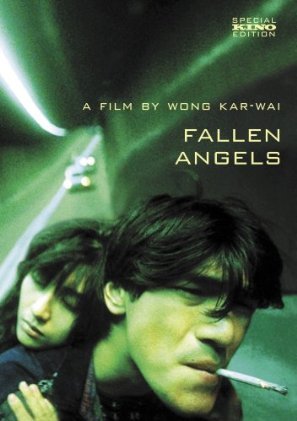
"Fallen Angels" (墮落天使) (1995),a movie depicting a set of interlocking and morbid relationships between people from different walks of lives. The leitmotif and many scenes are reminiscent of another Wong's production in 1994, ChungKing Express. The similarity between FA and CE was nicely summarized here.

 There are two major axes of relationship, that between the killer Leon Lai, his work partner Michelle Reis and the call girl Karen Mok , and between the mute boy Takeshi Kaneshiro and the heart-broken Charlie Yeung. A highly deterministic macro- atmosphere underlined the backdrop of this film. Leon worked as a hitman because he "doesn't have to make decisions". Who lives and who dies were pre-arranged for him by Michelle.  He is an executioner, not an executive or a judge. Takeshi was mute since childhood from food poisoning. He likes to barge into closed stores at nighttime to assume the role of the boss. Many comedic moments resulted from his repetitive coincidences with his "customers", yet his illicit lifestyle also shows his passivity to engage in pre-determined, pre-existing business without his own idiosyncrasy and decisions. Charlie was a desperate girl seeking out this "blondie" girl whom she believed to have stolen her boyfriend from her. Unable to extricate herself from an unrequited relationship, Takeshi discerned that Charlie was still in love with her boyfriend after some years apart. Karen was a paroxysmal ex-con indulging in one-night stands with Leo. Her desire "to be remembered" speaks to a flawed self-image that hinges on external appraisal for self-salvation. Consider the release date of the film, one possible reading is that the suffocating urban life and air reflects the mood of the impending reversion of sovereignty to People's Republic of China in 1997. Insinuating the inability and futility to make decisions and life choices, FA seems to imply that the future of HK is as uncertain and vain as the fate of the actors in the film.

A slit of silver lining is projected in the end of the movie, where Leo finally understands that he has to make decisions for himself before it is too late. Takeshi made a decision not to chase after Charlie as he found out that Charlie did not recognize him at all. Finally, the camera portrayed a close-up of Michelle, widely known as probably the prettiest Ms. HK. Her icy cold mood and ruminating look contrasted the hustling environ in the tea restaurant. She ran into Takeshi, who offered to take her home on his motorbike. Racing through an underground tunnel with her hair fluttering in the wind, she held onto Takeshi, and she confessed
"I haven't ridden a motorcycle for a long time. Actually, I haven't been so close to a man for a while. The road isn't that long, and I know I'm getting off soon. But I'm feeling such warmth this very moment."
 Urban fairy tales are fairly transient, but realizing ephemerality does not stop Michelle from enjoying the very breathing moment with a strange man.

Friday, June 10, 2011

Trilogy of Wong Kar-Wai 1

Wikipedia characterized the style of the award-winning HK director, Wong Kar Wai, in this way, "elliptically plotted mood pieces, with lush visuals and music, about the burden of memory on melancholic, misfit characters." Indeed, his movies are rich with metaphorical tropes, visual contrasts, and emotional subtlety. He is a master of the graphic representation of modern solitude, the emotional outcry of urbanites, and above all the social ambiguity and cultural juxtaposition of a society in flux.

"Days of Being Wild" (1990) (阿飛正傳) tells the story of a playboy whose failure to commit to any women stems from his familial history. Played by Leslie Cheung, he mastered the art of stealing girls' hearts with his artful lies ("I will remember you forever because of this minute") and his grasp of female psychological weaknesses. His womanizing capacity draws upon his troubled relationship with his adoptive mother who was a prostitute. Speaking with fluent Shanghainess and a set of typified fashion code of 50s/60s Shanghai, his adoptive mother was paid by his biological mother––a Filipino aristocrat––not to reveal her identity, much to the resentment of Leslie. His adoptive mother was engaged in bad romances with young men who approached her for her money. There is an important parallel between Leslie's treatment of his girlfriends (played by Maggie Cheung and Carina Lau) and his distaste of his adoptive mother. He saw how blind and self-deluding his adoptive mother was in bad romances, and he reconstructed these abusive relationships with other women (when Carina was desperately looking for Leslie as he left her, she unabashedly barged in the apartment of Leslie's adoptive mother. Carina asked if she was pathetic, the mother said "No, I was just like you when I was your age.") No matter how conceited he seemed to be in this hedonistic lifestyle, I think there's a part of him that knows something is wrong. The most revealing scene is the last moment before he was shot in a train in the Philippines in which the allegory of the flying birds without legs appeared again. As the core metaphorical thread weaving across the fabric of the film, the fable narrates the myth of a certain type of birds who are born without legs; incessant flying is necessary to keep them alive and the only instance of landing is the time they die. Leslie glorified this fable in the beginning of the movie, implying that his frivolous personality is as innate as this type of birds; standing in sharp contrast to his reflection on the allegory in his final breathing second, "I was wrong. The bird was dead from the start." Depriving of the ability of love, life is inane and hollow.

To be continued with "Fall Angels" (1995) and "Happy Together" (1997) in the next two posts.

Thursday, April 21, 2011

The Cherry Blossom

2008, a German film featuring love, death, and foreign art are the keywords I'd put up for the beautifully presented film "The Cherry Blossom".

Hanami (花見) and Japanese folk arts brought a mourning German man to his recently deceased wife and his (un)timely death. Laid dead by the lake side against the backdrop of snow-capped Mt. Fuji in a female Kimono and courtesan makeup, Rudi returned to the arms of his wife in his final imaginary dance. The background melody––"Little Black Book"–– is captivating. A few simple notes in a serene key correspond nicely with every little body twitch: the turn, the stretch, the drag, the drop. As if time was frozen and reversed by this perfect orchestration, his wife came back from the coffin to join him for the final moment.


The melody stopped. He clenched, and collapsed in her kimono. This is what true love is: transcendental of life and death, outside of space and time, boundless by language and culture, and communicable through arts and hearts. Life is finite, love is infinite.

Saturday, April 16, 2011

The Human Experience


I normally don't look up to azcentral.com for their op-ed or reviews, but I am with Lengel on the brief review of "The Human Experience" released three years ago, now on netflix streaming. An attempt to capture the plurality of human experiences in a singular term (we are all human), THE presents a generally upbeat, optimistic meaning-searching documentary. I'd say it's a good film for the chronically depressed but not a sophisticated intellectual examination.

The best thing from watching THE is–get this–Ben Hurlbut's father Dr. William Hurlbut from Stanford Medical Center appeared recurrently in the film. Like father, like son.

Wednesday, March 23, 2011

An Angel at my Table


"An Angel at my table" is based on the autobiography of the New Zealand writer Janet Frame. The movie was filmed in 3 installments, straddling across her childhood, adolescent and post-adolescent life, hovering around the central idea that "life sucks; people die out; writing heals and lasts".

Frame was haunted by embarrassing encounters with friends and teachers at an early age. Even though she got good grades from class, she had a rather sullen childhood. She was forbidden to see her best friend, was constantly mocked by classmates about her unsightly teeth and fizzy hair. Ushering into her college stage, she was mistakenly diagnosed with schizophrenia and was forced to receive electric shock treatment for over 200 times in 8 years. Discharged from the hospital, she traveled across England, Paris, and Spain (Andorra) and tasted the first drop of dew from the fountain of love. Later abandoned by her American lover and several family members, she dedicated her life to writing, for "writing comforted me". Her deep passion in literature and poetry were conveyed in the multi-volume autobiographies, and award-winning novels and short stories. Everyone writers, but someone writers to execute an order (a hallmark postcard designer is not much different from a Gulag propagandist), someone scribbles something and never looks back (ever graded a poorly written, typo-ridden term paper from a freshman?). In the end, there are individuals who write with their hearts, and souls.

As the NYT review beautifully puts it—"in the end, literature conquers all"–and so it seems words and paragraphs are powerful tool to fill up the blank page of our lives. Next time as you struggle to write/rewrite/read/re-read/revise/re-revise a draft on a messy desk, remember you are watched by an invisible angel above your head, kissing your keystroking fingers.

Tuesday, August 17, 2010

8 mile


"Look, if you have one shot, one opportunity to seize everything you ever wanted, one moment. Would you capture it? Or just let it slip."

Here are several things I know about 8 mile. I know it's about Eminem, I know it's released in 2002, I think it's about rap culture. But I did not expect to see Brittany Murphy, whom I first saw in Ramen girl before her sudden death last year. I also did not expect I could find so much commonality with the perspective expressed in this movie.

The movie surrounds the life of Jimmy Smith (Eminem) from the lower stratum in Detroit. He got his girlfriend pregnant, then moved back with his mum in a trailer, where his mum is living with a man of his age and his little sister. Jimmy hangs out with mostly Black gangsters and rappers. The crux of the movie is Jimmy's run in a rap battle operated by his DJ friend. The psychological barrier, the stage freight, the economic pressure, the race issues etc. are rhythmically summarized in Eminem's rap song "Lost yourself". The prologue of the song is excerpted at the head of this entry.

Not only am I an Asian girl, I am also a fob, a PhD student from the Far East. These qualities make me the farthest type of outsider to a rapper community and its culture. Honestly I couldn't have understood the lyrics without subtitles. Too fast, and too tongue tweaky and sliding for me to grasp. There are obvious material and cultural demarcation separating my connection with this tribe. I don't want to pretend I'll ever understand or not understand anything about the hip-hop culture but at the core I think it portrays a psychological need to get accepted by people you identify with. In order to do so, you need to overcome the physical inconvenience (like being a wigga among a Black community) and bootstrap yourself for the best performance. People recognize accomplishment and results, not the physical attributes of the performers, although they are by no means eliminated.

Everyone has had many opportunities presented to them at one point or another in their lives. Indeed, life is the best gift we've ever had. Say no more and give your best show to every audience you are lucky to encounter in your life.

Saturday, August 7, 2010

Rich lechers in the 20th C: The Aviator, The people vs. Larry Flynt


Two biopics to be reviewed for this week's entertainment assignment.

The first one is "The Aviator", chronicling the life trajectory of the obsessive-compulsive mogul Howard Hughes and the other is "The people vs. Larry Flynt", featuring the pruriently political story of Larry Flynt. Both biopics are about American millionaires of great achievements. Although neither Hughes or Flynt is well-educated or respectfully decent in the orthodox sense, they are well-known public figures in the 20th C for their unswerving pursuit of their belief. This is the common highlight of both movies: Endure the hardship and keep on believing and pursuing whatever you believe in, and you will eventually win the public vote of championship. But would either man rise to their stardoms were they not wealthy? Would they gain public support if they could not financially sustain the long and costly legal battles with the US government? What is more important? Their affluence or perseverance?

At any rate, I am impressed that the US provided a public space to accommodate and commemorate these unorthodox figures. For better or worse, I doubt if the same status will be assigned to either man, esp. the porno king Flynt, in the Chinese society. But the nation-wide respect to these rich lechers in the 20th century also reinforce the intensified structural inequality. As sexually alluring as Althea Flynt is (Courtney Love is flawless in her character, I mean, WOW!), she was married to Larry Flynt when she was 17 and died at the age of 33. What does it tell us about gender relations of this couple? What does it tell us about the growing salacity of media violence today? These two men might have made irreplaceable private achievements but they also paved the public road for "American Philistinism". Is this as celebratory as the victory over the triumph of the First Amendment?


But who am I to judge? At least they have the guts to go nuts and coarse, right? Somehow I don't feel bad about my strict upbringing. Substituting bad taste with freedom doesn't sound too ambitious to me.

Monday, August 2, 2010

ChungKing Express


Is Chungking Express, a 1994 award-winning production of Wong Kar Wai, an expressed story of ChungKing Mansion in HK?


This is also my driving question in watching this movie. Well, the answer is yes and no. ChungKing Mansion appears in the beginning of the film, embodied with intensional shaky shots with the embarrassed-looking Indies and Pakistanis, but the building is not the focus. What, then, is the focus? If you have any previous experiences with Wong Ka Wai's movies, you know this is not an easy question.

It is a movie about the inevitable expiration of consumer products with expiring dates inscribed on the canned fruits; it is a movie about the predictable loneliness to spend your birthday at a definite time in the future. Yet it also a movie about the unexpected encounters with strangers at the crisscross intersections everywhere in a metropolitan city; it is also about the unpredicted gain and loss with human emotions and connections. In a city where relationships and romances are popularized and randomized by technology and material exchange, true love is not expedited; rather spurning is assisted by cell phones and beepers. Happiness is still obscured by opaque happenstances whereas sadness and despair are enhanced by precise calendars, reminding us the mechanical progression of time and the symbolized inevitable loneliness incurred on us.

If there is anything that keeps us alive in a self-destructive city, it is the indefatigable search and hope in finding truth and eternity. Keep on believing, as Angela Aki beautifully utters. Tony Leung finally met Faye Wong, a year after waiting for Wong's unplanned return from an adventure in California. Was this within his expectation? Probably not within the capacity of logical calculation, but an act of faith in yourself and in the eventual kindness of life.

Now, this is what ChungKing Express is about.

Saturday, July 24, 2010

Nothing but the truth

"Nothing but the truth" is a political thriller that upsets your normative assumption on American democracy and civil liberty. It is based on a real event about the prosecution of a journalist for releasing intelligence information with regard to national security. The balance of "First Amendment" against "national security" is clearly tipped towards the latter. National security and cultural treason trump freedom of information and civil autonomy.


What is ridiculous in this fictional story is that the perceived national threat is actually a little girl, the daughter of the CIA agent, who later got killed by a hyper-nationalist right-wing idiot. The journalist who reported the case has to bear the unintended consequences of her acts. Besides the issue of the encroachment of civil liberty, it also delivers the message that sometimes the scope of consequences of our choices is not within our control and that it is best not to be over-confident on certain risky choices that we are not certain of. It is true that the magnitude of risk is proportional to that of consequence (good or bad). But as one of the commentators wrote on thelastpsychiatrist's blog,


"All of our actions have a blast radius, and other human beings are in it. Other human beings, not just long, repetitive strings of common organic molecules."


Well said indeed, and well filmed in this movie. Rachel Armstrong is every way as righteous a journalist as she is a good mother. She believes in telling the truth, in confronting the bullies, and has every bit of faith in the democratic legal system of her country. She is admirable but too ignorant of the consequences of her choice. Not only did she spend a year in jail, she also sacrificed her personal life on top of another 2 years sentence in prison. But the personal cost is not as gigantuan as the cost of the little girl who could not have borne the fact the her innocent act of tattletale indirectly is the cause of her mother. Perhaps the Chinese proverb says it better than anything: 我不殺伯仁,伯仁卻因我而死。


This reminds of the scene in "Good Will Hunting" where the genius protagonist Will Hunting was offered a government job for some oil companies and he declined after a prognostic imagination of the complexity of the job position. As the saying goes, "caution is the parent of safety".

Thursday, July 22, 2010

Hiroshima Mon Armour


I never quite get the sense of what happened to poor Hiroshima in the WWII. I mean, I read about how the pearl harbor attack led to the decision of dropping bombs by Truman and hard facts like that, but Hiroshima is too distant a piece of historical memory to me. I wish there were more near-distanced, perceptible experiences available to me, whether visual or cognitive kinds like this one. Sometimes I daydreamed about landing on Hiroshima one day, with a suitcase and my laptop, ready to bitch about how my footprint matters to no one in and out of Hiroshima except the ego in my mind.


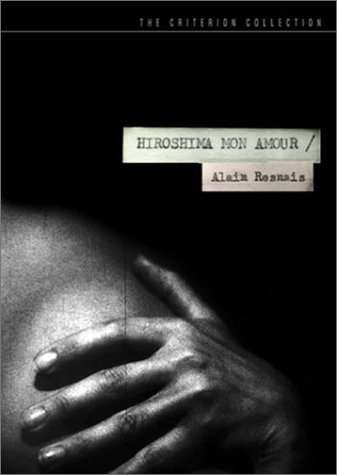
It was against this estranged backdrop that Hiroshima Mon Armor stands out from the ocean of foreign movies on romantic affairs. It bestows this tragic place a romanticized flavor to sustain your interest in the heavy discussion of technology-assisted world conflicts. This is delicately achieved by adept fornication: the fleshy display of epidermic communication as you can see in the poster. While lighting and hand gesture made the posture quite questionable, the bodily contact was smoothly shot in the motion picture, simply natural and aesthetic. It was shot in the black and white era so the sex portrayal was filmed in a more non-explicit way, compared to the level of acceptance nowadays: no disclosure of any testicles for example. Yet the element of intimacy is not undermined by the cinematographic obscurity; in fact the subtlety allows more room for imagination: you can picture how the union of the two spirits are conjoined in the union of their body parts, and the soft play of human affairs is interjected with the heavy part of world politics, all in your mind. What replace the flavorless type of licentious, hard-core porno stuff is an unlimited internal capsule.


All movies are romanticized representations of an insipid snapshot one way or another, or they are not movies. True, but Hiroshima Mon Armour is a “romanticized” account in the literal sense: a trans-continental hiccup of a love affair between trans-racial, trans-cultural couple. A married French actress hooked up with a married Japanese ambassador in post-war Hiroshima. As the woman revealed her past in Nevers, France and what she saw around social spaces in Hiroshima, the filmroll slowly took us to a new territory where Nevers met Hiroshima as their bodies were enmeshed in each other. The distant history of the two places became relevant and interesting now as the public dossier is entangled with the private union of two individuals. The intersection between private and public facets is sprinkled with mind-boggling but lovely philosophical lines like this one


"just as the illusion exists in love, the illusion you can never forget, so I was under the illusion I would never forget Hiroshima, just like with love."


Hiroshima Mon Armou is an embodiment of pure aesthetics, delusion, and disillusion. Ironically, or better say, superbly, it is through the deconstruction of the delusion of love that comes that disillusion of war history and love affairs.


Sunday, July 4, 2010

The Mist

先說電影本身,很震撼,發人深省。Mrs Carmody 有我以前認識的某美國隊伍軍人的影子:宣揚宗教的人,除非本身可以超越人類自私,貪婪,恐懼的個性,否則和獨裁者差不了多少。豆瓣上的評論很好,討論也很有意思。超市的人大概可以分為信自己和信他人的人。信他人的人,就是那個沒用的超市技工,一開始逞英雄,遇到考驗時第一時間垮了,然後他不斷尋找可靠的領袖作為自己的精神寄託,先是男主角,後來是Mrs. Carmody (我不同意稱呼她為瘋婆子,因為我覺得她由始至終不是在發瘋,她是有意迷惑大眾從而鞏固自己的權力)。信奉他人的人看上去很可悲,但是人類往往就是這麼可悲的動物。世態炎涼,變幻無常,存活下去需要力量,需要理想,而在絕處時刻,人的心靈更顯脆弱;信自己的人,靠理性思考,靠行動去對抗現實的無奈,但是理性的終極是狂妄。就像美國前總統Woodrow Wilson在一戰時宣揚美國會以“理性“(reason) 去處理國際政治那樣偽善,不切實際。

如果說,男主角最後開槍射殺自己的孩子是兌現對孩子的承諾(Billy在超市要求爸爸保護自己不讓怪物吃掉),那為甚麼其他人也甘願 “自殺”呢?槍本來就是屬於女主角的,她臨死時臉露懼色,為甚麼她不選擇自行了斷?為甚麼寧願把自己的命和自己的武器交到別人手上呢?也許人在極度恐慌的情況下無法顧及那麼多;也許經過了那麼多恐怖的場面後,車上的人都把精神和信任寄託在唯一的英雄身上;也許這是電影情節需要;我想在某程度上,當時車上的人並不是原意被男主角“行刑”,而是原意被 “理性”行刑。車上的老人說 “我們至少嘗試了”––嘗試勇敢地闖入迷霧當人,嘗試用自己的雙手主宰自己的命運,嘗試以理性判斷下一步的行動,甚至到無計可施了,寧可以理性來推算未來(電影尾端的一片荒涼,龐大的怪獸等等是在製造環境證據讓車上那些以‘理性’自居的人相信已到了窮途末路)也不原意相信未來的不可預測性。觀眾可以用事後的目光輕鬆的說句‘為甚麼不等一下呢?等一下說不定就有救了.’但是從當時的情況推斷,從車上的人的觀點出發,真的有必要等救援嗎?經過 Mrs. Carmody的荒誕鬧劇,你想他們仍然相信會有救星嗎?

5個人4顆子彈是導演刻意安排,但是理性的極限是結局的重點,也是整套電影最有感染力的地方:在超市時面對觸鬚,各種自然界的怪物,人類當中的敗類,理性顯然是較好的選擇;David也一次又一次地向同胞們證明理性的效用;但是到了對目標毫無頭緒時,理性拜倒了。在迷霧中,在無法掌握可靠數據的情況下(沒有電話,沒有雷達,沒有任何通訊儀器),相信理性有其代價(他們所有人都付出了那沈重的代價),但要放下一直深信不疑的理性是很難的。這大概是導演想傳達的訊息吧:相信絕對的理性等於不理性,但是美國一直以來依靠科學和理性思維帶來的斐然功績把美國人困在一輛沒有燃油的車上,無法前行,這時要人們反思具首位的科學理性價值觀是很難的。一直以來男主角的判斷都很合理,不然他不會有一群忠實的支持者,所以他才會不顧一切堅持理性。沒有科學帶來的成就,沒有其他意識形態的襯托,沒有其他國家衰亡的比較,美國人甚至乎所有現代人類不會如此崇拜科學精神,理性主義。突然說要反省,談何容易?

理性的悲劇,象徵著人類文明的極限。科學曾經照亮人類的社會,在迷霧中為人們開路,但是迷霧是無窮無盡的,為科學留下一點空間,為下一代積一點福吧。

Wednesday, May 26, 2010

Goodbye Lenin


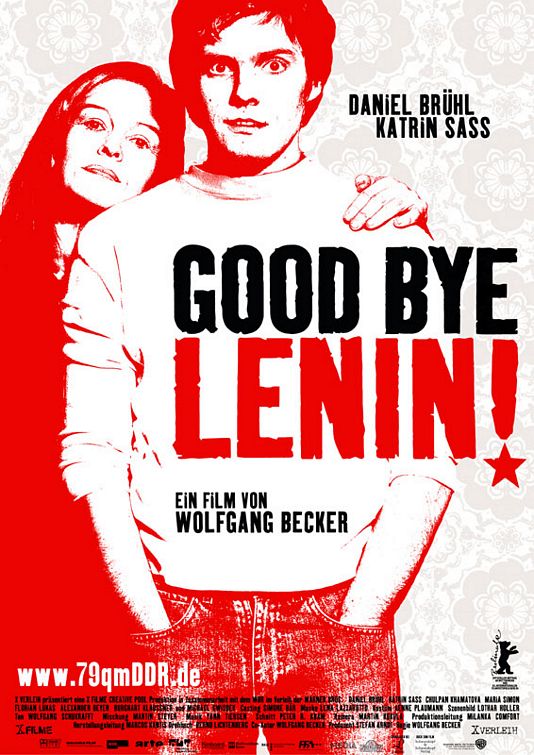
Goodbye Lenin: a masterpiece of a familial history against the backdrop of the collapse of the Berlin Wall in 1989. The core message, as I interpret it, is that each individual try their best to adapt to the colossal social change that results from the uneasy interaction of the discrepant political ideologies. Alex made tremendous efforts to create fictional representations of the capitalized East Germany so as not to upset his socialist-bent mother who was in coma during the fall of the Berlin Wall. Some of the fabricated news he produced with his friends are simply hilarious!


Yet the film is also full of meticulous symbolism and metaphors to contrast the deceptive exposures and uncomfortable experiences of people trying to make sense of the two political systems.Wolfgang Becker is very skillful in using different representations of signs at different critical moments to deliver the changing conceptions and understandings of these signs. One good example to illustrate this point is the two-timed blindfolding of Alex’s mother. She was blindfolded at the beginning of the film after she was discharged from the hospital. She lied to her children about their father’s departure and was “married to the socialist fatherland” after that. She was blindfolded again toward the end of the film on the drive way to the garden house. This time she confessed to her children about the truth of their father’s escape, which unequivocally debunked the cruel socialist regime. She “lied” again by pretending to believe in the fabricated news Alex prepared for her the last time even though she was already briefed by Alex’s girlfriend about the truth. The message the director wants to get across through showing the different reactions of Alex’s mother towards the blindfolding plot––a sign symbolizing the disguise of truth–––is the continuous construction of deception for different purposes. In a way, her mother came clean about her propagandized feeling about idealized socialist goods because her husband was forced to leave the country for his non-affiliation to the party. However, the deception continues after her confession for protecting her son’s dignity and feeling. Alex was convicted that his mother “never learned the truth” in her coffin, thanks to his hardwork. It was Alex who was “blindfolded” unconsciously in his flawless facade and filial piety. At both occasions, his mother used deception to achieve what she thought was good for her children, to their oblivion. The repetition of deception also implies that there are only selective interpretation of history. Nobody in this film is crystal clear about the holistic picture of the social history. Everyone knows a little and endeavors to fit the bits and pieces of the history that they grasped to fit in their existing framework to make life bearable for each individual.


Here are some well-written quotes from fellow reviewers on imdb, way better than I could ever have put it:


"Against this tapestry of myth we watch contemporary politics play out, trying desperately to spin events into frameworks that reinforce our desires for justice and virtue."

"We are all Alex, trying to reconstruct a new view of history that makes us more proud of where we come from. We invent and reinvent history to suit our needs and like Alex, do so in the name of providing a safe environment (or better way of life) for others."


Tuesday, May 25, 2010

The Great Happiness Space


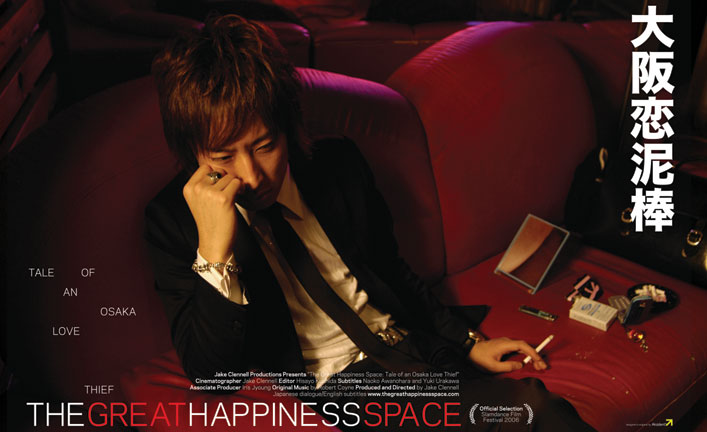
Finally putting an end to the unplanned Monday’s movie marathon, thanks to this award-winning documentary produced in 2006. At first I assumed the Great Happiness Space would be delightful and colorful (given its title and the cover page) but not quite expected to go so deep as to uncovering the psychological malaise among the Japanese youth.


Counter to my predication, it is NOT a (syndicate) tale of Japanese gigolo/entertainer wealthy women in Japan, rather it is a reality-cum-documentary film recording the real lives and interviews of the male employers (hosts) and the male customers working in the second largest city in Japan: Osaka. Incidentally, the entertainment spot is located in Minami, where I had visited in winter 2008 with my then-fiance. Had I been more responsible for planning my travels, I would have been more informed of the cultural role and impact of these places that I was lucky enough to leave footprints.


Back to the film, if you think that this business is just a harmless form of entertainment, where young, good-looking men are paid to fondle with the spendthrift women, or even a triumph of feminist rights of some sort, you couldn’t have been more wrong. It turns out that most female customers gave away their normal lives to work as cabaret girls, call girls, and even prostitutes (fuzoku) in order to afford the exorbitant costs in these host clubs. In exchange, the male hosts praise these girls, drink with them, and make them feel important and “loved”. Having understood the female psyche to indulge in self-deceitful dreams, the male hosts confessed “we sell dreams, that’s our job.” It really saddens me when one of the female client related, “I am not buying guys, I’m buying times.” As if there are no better ways to burn their energies; as if the only way to acquire a positive self-image is through telling lies and engaging in a mutually hurtful act of fooling around where both parties feel guilty and shameful of what they did in order to make money and make themselves “happy”.


The system needs a break. But the revolutionary forces will not come from within. Here the male workers seem to get it “people are not always strong, esp. when they are alone.” This is where a communal action comes into play. Through education, persistent resistance to evil temptations, consciousness-raising, and genuine sharing and respect, we can fight off these immoral and malicious money-sucking businesses. We need to be strong, not for some transcendental mighty goals, but simply for getting what we want. Is money what people really want? Or is it a means to the more primitive human needs? Money in the form of printed paper can never be the ultimate goal for what we are fighting for. Money can only be meaningful in stratifying and stimulating social relationship. A bucket of gold loses its luster if you lost track of what you really want in your life. This is why the idolized and highly paid male host wants a trustable girlfriend after all. And he realized what he lost is way more expensive than what these girls pay him: the ability to trust, and love other human beings.


We need more people to respectfully heal these damaged souls, we need to rescue them (not through a man-made sculpture and a text of gospel) but to help them gain perspectives, to realize that there is alternatives, that meaningful human interaction is within the realm of reason and hope, that history is replete of strong, solitary peoples enduring hardship and loneliness for something much more desirable and authentic. All in all, people (esp. girls) need to understand that nobody can take control of your own life unless you allow them to.


I highly recommend this movie to anyone who is interested in understanding Japanese subcultures.

Sunday, May 23, 2010

some so-and-so movies n the 80s


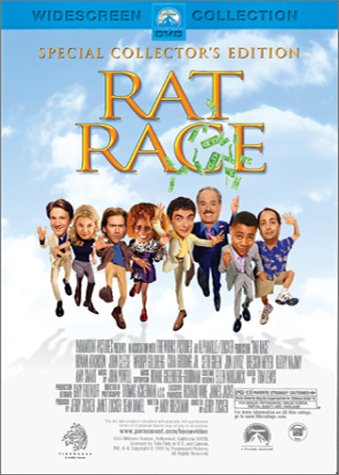
The rat race–set in LV, the Strip. The reality show “the amazing race” was inspired by this show. Pretty funny. Recommended if you want a peep of the VIP room at the top of Venetian and ridiculous gambles the nouveau riche enjoy. Also good for some much-needed laughter.


The Princess bride–not a fan of a classical linear plot culminated with the beautiful, charming princess getting rescued by her plebeian love. Over-rated in American folklores, but pretty harmless for a family to kill an evening.


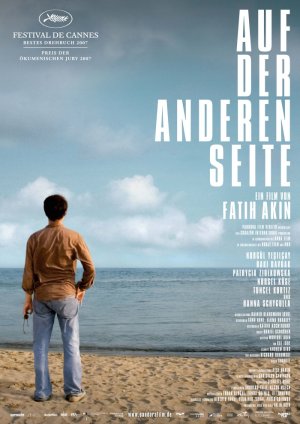
The edge of heaven


The Edge of heaven (the German original title is Auf Der Anderen Seite) is set in Bremen (Germany) and Istanbul (Turkey). The story incorporates the elements of political activism, economic hardship and homosexuality as the unexpected encounter and departure are coincided throughout the storyline.


The Turkish immigrant father-son living in German met the Turkish prostitute in the same city. Then the son was convicted to help out the education of the prostitute’s daughter after his father accidentally killed her. Meanwhile, Ayten, the daughter of the prostitute who fought for the Turkish communist resistance group escaped to Germany. Ayten met a female German university student and they fell in love. The mother of the German girl was not happy with Ayten’s stay. Ayten was busted by the police and a political asylum was not granted. Lotte (the german girl) rushed to Istanbul, hoping to help Ayten get out of the prison. And here is where the two separate story threads intersects: Lotte found herself at the bookstore run by the Nejat, the Turkish son whose purpose is to help out Ayten and stayed with Nejat. Up until the end of the film, Nejat still did not know of this intersecting point. The story was rolling on: Lotte was innocently killed in an accentual shooting by juvenile pickpockets Lotte’s mother came to Istanbul to reclaim her daughter’s body. She found Nejat and liked to stay in the same room Lotte used to live in. She read through her daughter’s diary and understood her commitment in helping out Ayten. I couldn’t resist my tears from falling off my cheeks as she told Ayten that she forgave her and even wanted to help her. Ayten was very touched. You can tell she felt responsible for indirectly causing Lotte’s death. So she signed up for a repent with the Turkish government and was discharged. She met Lotte’s mother as Nejat forgave his father’s crime and waited for him along the coast.


One of my favorite European movies integrating political activism with personal vicissitudes.

Saturday, January 30, 2010

Gattaca


Science tells us what to believe and what not to believe. But perhaps even the highly unlikely 1% is worth pursuing. After all life is full of contingency and indeterminacy. If we do not allow any room for chances and flukes in addition to demonstrable scientific evidence, we are only fooling ourselves.

The film explores the ethical questions about the limit of genetic predilection and the consequences when we allow genetics to dictate our belief and social organization. Jerome Morrow has the perfect genetic makeups but he's crippled in real life whereas Vincent has congenital heart problems but he works very hard to maximize his potentials towards realizing his dream of joining the space mission program "Gattaca". The non-negotiable policy of only allowing the best genetic composition to join the space mission motivates Vincent to assume the identity of Jerome. He realized his dream in the end but only as an impostor. The problem rests with the blind belief in extreme genetic superiority, excluding any consideration of epigenetic factors such as accidents (Jerome's 'perfect' genome cannot predict traffic accident), and miracles (Vincent's 'defective'' genome cannot stop his strong will power).

No wonder Lou likes this so much, Vincent and Jerome in the movie are modeled after the same genetic line. The two individuals with drastically different genes, upbringings, appearances, aspirations pretend to live under the cloak of the same set of genetic materials. In a sense, they are fraudulent identical twins. They fell in love with the same woman: Irene, and the same sport: swimming. Other than that, the genetic shell they carry over did not determine their different outlooks in life. One of the take-home messages is that people who share or pretend to share the same genetic materials are not prisoners of their genes. Life is not just a bundle of genes. Jane put it wonderfully in her award-winning book Whose View of Life? , "But the genome is nothing without the organisms. DNA maybe interchangeable from one organism to another, or even from a laboratory dish, but DNA is just the beginning."

This film was produced in 1997, a nice reflection of the "century of the gene" as the twentieth century is characterized. That century is over, and gone too is the simplistic emphasis on the gene and on genomics as the path to truth and life. Jane said "we are moving into a century of the organism, an era in which we will embrace the complexities of interactions."

Tuesday, January 19, 2010

500 Days of Summer

"You cannot ascribe cosmic significance to simple earthly matters. That's all everything ever is. Nothing more than coincidence. It took a long time, but Tom had finally learned. There are no miracles. There is no such thing as fate. Nothing is meant to be. He knew. He was pretty sure."

My favorite line from this 2009 movie. Like the amassed reviews at rottentomatoes, it is a movie with which most people can resonate in their romantic lives. On many levels I relate myself with both Summer and Tom. The non-linear depiction of the ups and downs in a relationship; the juxtaposed snapshots between expectations and reality; the emotional hopping from infatuation to desperation, from affection to desolation, from deep belief to light relief, the film is filled with novel presentation techniques. If only life can be neatly broken down into these categories, or if relationships and feelings can be demystified at all, perhaps life wouldn't be as complicated as we know it.

I think the most powerful theme covered in this movie is the uncertainty in relationships, and to certain extents, life in general. The Chinese sages used the concept "fate" to help people make sense of the happenstance in our life paths; the French counterpart is something like "je ne sais quoi". But it is the tendency for people, esp. people in modernity in which great success have been harnessed from investing in science and technology to grab something more tangible, more explainable, more predictable. In the end, it is a battle between man vs. unknown world. Relationships are full of surprises, fickleness, sometimes with thorny pick, sometimes blessed with infinite mercy. We don't really know.

What is certain is that nothing is certain. Pretty lame hah? So Summer is married to someone else. The movie doesn't focus on Summer's emotional path but can she be certain that she is married to "the one"? Well, no one knows. There can only be hopes and prays, which is why I like the ending of the movie when the cycle begins as Tom picked up the nerve to ask the woman at the interview lounge out. The truth is, the cycle of uncertainty never stops running. Einstein once said "life is like riding a bicycle. To keep your balance you must keep pedaling."

Here is my favorite soundtrack. "Hero" by Regina Spektor:


Sunday, January 17, 2010

The Hidden Blade

This evening is blessed by the pleasant surprise of "The Hidden Blade", a Japanese movie on samurai's culture. Here is the trailer from YouTube.

The Hidden Blade is the second movie in Yamada Yoji's samurai trilogy. It came out in 2004 after the highly successful "Samurai Twilight". The story depicted the confusion and struggle a samurai hero went through in choosing between friendship and fulfilling his duty to his senior squire. Women appear as domestic house-makers, geishas and sexualized object in HB, as in most samurai's movies (the adorable Takako Matsu was the leading actress in this movie !) But there is an extraordinary sense of femininity exhibited in these women's day-to-day activities. They were born worthless in Tokugawa feudalism, but they are hard-working, demure,virtuous, and above all, simply stunning in their Kimonos with zori. In retrospect, the beautiful skin textures shared by these women who belong to the lower castes ( for example, Takako was the daughter of a farmer and a bondservant to Katagiri's family) seem unrealistic and phony. But the tempting presentation of these female figures is very irresistible even to a woman like me.

The movie also explores the identity struggle during the transitional period among the Bakufu samurais. The introduction of western science and the technology left took place in the castles where established samurais were required to learn how to operate cannons and gunpowders. The cultural clash between Western military science and samurai tradition is amplified in the plot where Hazama–Katagiri's best friend–was killed not by a blade, but a rifle. Katagiri's condolence before Hazama's corpse sums up everything: "as a samurai, I know you would rather die under a blade than a gun."

Ritual suicides in the form of harakiri (disembowelment) are documented and mocked in Kobayashi's timeless work, but this movie adds another dimension into the overall framework of death honor. The highest form of death honor a samurai can receive is through harakiri, if not, at least he should die under a blade, the traditional form of weapon inherited in the Japanese samurai culture. To be killed by a foreign weapon destroys a samurai. The intrusion of Western science desecrates the system of death honor for samurai. My guess is that ritual suicides is rendered incomprehensible and irrational under a foreign eye, established through the use of weapons and tools. Interestingly, there is not a trace of "foreigners" throughout the movie and the foreign invasion of the Japanese samurai culture was embodied by technology. In a limited sense, Western technology obliterates ritual suicides through military conduit. This is a core theme circulated in the film.

Also read the first half of "River Town" by Peter Hessler. Review is forthcoming.

Sunday, March 1, 2009

Pipi my idol


Love Pipi Longstocking. She is my heroine and quite a feminist role model. She lives alone, with 2 animals. She is bizarrely strong, resilient, creative and lively. In one episode, she was watering the plant while raining. Her friend Anna asked her why she watered in a rainy day. She said "when I make up my mind to rain, I do it, and it can rain as much as it wants." What a line! She inspires me, despite the ostensible surrealism (such as raising a quadroped with her bare arms, and jumping off the cliff without injuries). When I make up my mind to run a project, I do it, and people can be as much indifferent or critical as they want. I don't care. Pipi always believes in herself. She is righteous and she outperformed men in many areas. She is unbelievably strong enough to protect herself and others. She is unusally rich enough to live on her own and buy confectionery and toys for other kids.

Defiant of authority, overflow of confidence, independence, bravity.....she is exactly what every girl needs to aspire to. I know I would be much better off if I can keep her in my heart forever.